Offline ZIM search server with MCP connectivity for AI agents
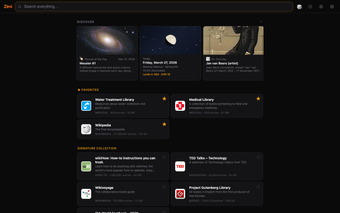
Zimi, from Epheterson, is an offline search and browsing server that turns ZIM archives into a queryable knowledge base, designed to supply AI agents and human users in disconnected environments. It indexes multiple ZIM libraries, serves a modern web UI for manual browsing, and exposes a fast JSON API plus a built-in Model Context Protocol server for agent access. The tool targets AI developers, researchers, and power users who maintain large offline datasets and need programmatic access to archived web content.
Which real tasks does it support for AI agents and researchers?
The app supplies archived content as retrievable context that agents and scripts can use to ground responses instead of querying the live web. It returns search hits and page fragments in structured JSON for downstream processing, so teams can run retrieval-augmented generation experiments or offline Q&A without external connectivity. Typical uses include offline research, dataset curation, and local testing of agent-source attribution.
How dependable are the search results compared to live sources?
Reliability reflects the state of the stored snapshots; content accuracy matches the originating ZIM files, for example Wikipedia or Stack Overflow dumps. The app includes self-updating mechanics to refresh libraries when a connection is available, but any retrieved answer is limited to what those archives contain at snapshot time. Search is engineered for high-speed queries across multiple large archives simultaneously.
What inputs and runtime constraints determine usefulness?
The tool accepts ZIM-format archives and requires a server environment compatible with Node.js or similar hosting. It integrates with Model Context Protocol clients that follow MCP conventions, and strictly offline deployments must plan for manual archive updates because self-updating requires network access. Non-ZIM sources need conversion before indexing, which adds an extra preprocessing step to ingest pipelines.
Is it practical to fit into existing AI development workflows?
Programmatic access and library management target developer workflows by exposing a fast JSON API and tools to organize and update offline content. The web UI permits manual inspection and debugging of search results, while the API supports automated ingest, retrieval, and test harnesses. These elements make the app suitable for teams that treat archived knowledge as a controlled data layer for experiments and agent grounding.
Who should adopt it and what to watch for
The app is a practical choice for developers and researchers needing verifiable, offline knowledge snapshots to ground agent responses. Its value depends on an established process for curating and refreshing ZIM libraries; without that, retrieved context may lag current sources. Deploy it when controlled, repeatable retrieval from archived web content matters more than live web freshness, and plan archive maintenance accordingly.